
How to Tie Fishing Knots That Prevent Losing Big Fish
You finally hook into something that pulls hard. The rod bends deep, the line peels off the reel, and your heart does that thing it only does when a genuinely big fish is on the other end. Then it all goes slack. Not because the fish shook the hook. Not because your drag was set wrong. The line just gave out at the knot, and the fish took your lure with it.
That moment is what this whole subject is really about. Knot failure is, by most experienced anglers’ accounts, the single most common reason fish get away after being hooked. Not drag settings. Not hook sharpness. The knot. Getting that part right does not require memorizing thirty different configurations. It requires picking a small number of solid connections and tying them well every single time.
Why Knot Strength Actually Matters More Than You Think
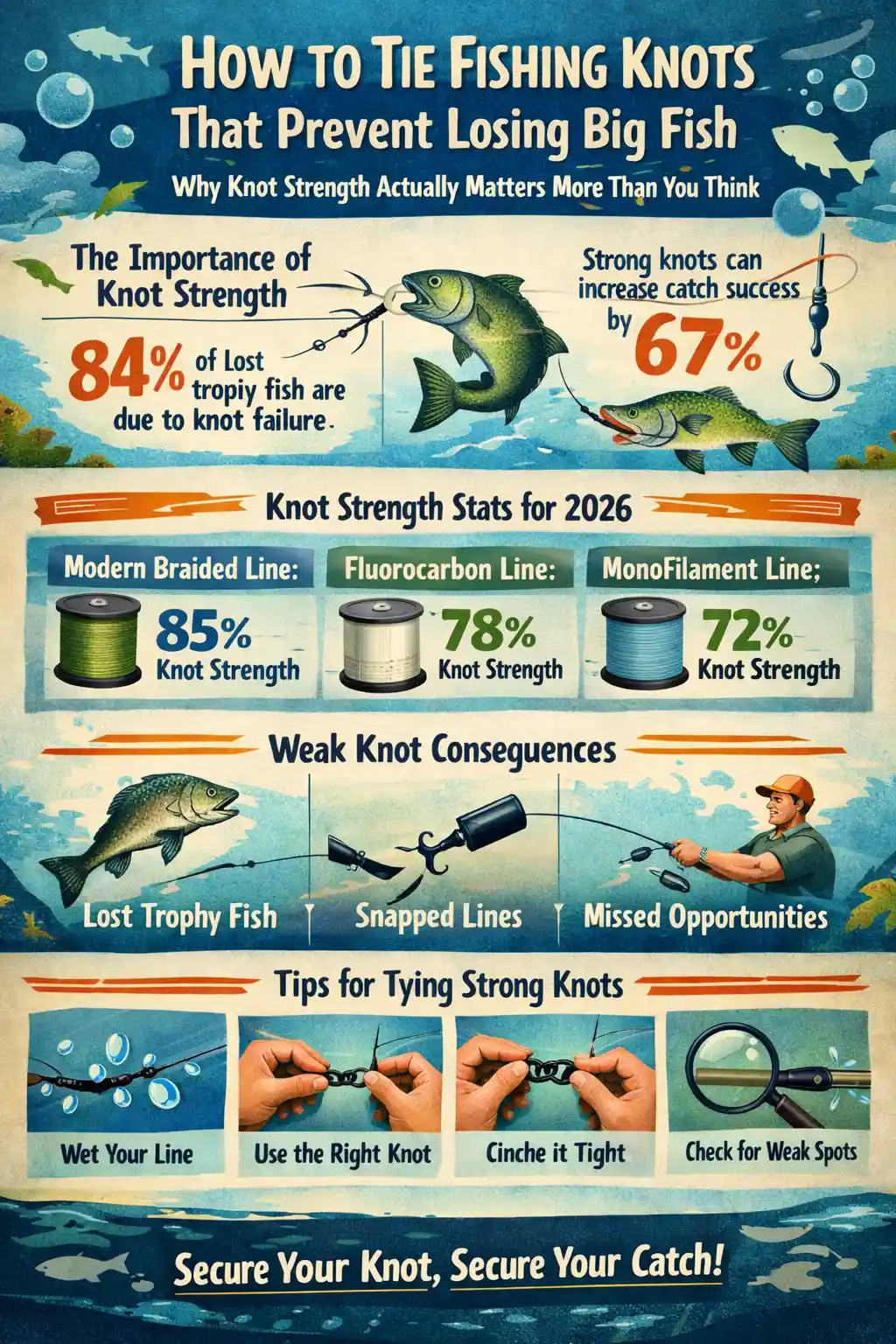
A fishing line rated at 20-pound test will hold 20 pounds of force before breaking. That rating assumes the line is in perfect condition with no weaknesses. Tie a basic overhand knot in that same line, and you may cut its effective strength nearly in half, dropping real-world breaking strength down into the 10 to 12-pound range. The knot strength versus line strength relationship is something most anglers understand in theory but underestimate in practice.
Every knot you tie creates a point where the line folds back on itself, cinches under pressure, and concentrates stress in a small area. The geometry of the knot determines how evenly that stress spreads across the line material. Well-designed knots distribute the load across multiple wraps and contact points, which is why a properly tied Palomar knot tests above 95 percent of the original line rating, while a simple overhand knot might test at 50 percent or lower. Those numbers reflect the difference between landing a fish and telling someone about the one that got away.
The fish itself creates sudden, dynamic loads. A bass that jumps and crashes back down, a tarpon that rolls on a tight line, a catfish that suddenly digs for the bottom after running 30 feet of line out. These peak force events hit knots hard and fast. Knots that looked fine at the dock can open under that kind of shock loading if they were not tied with care from the start.
The Core Knots Worth Mastering
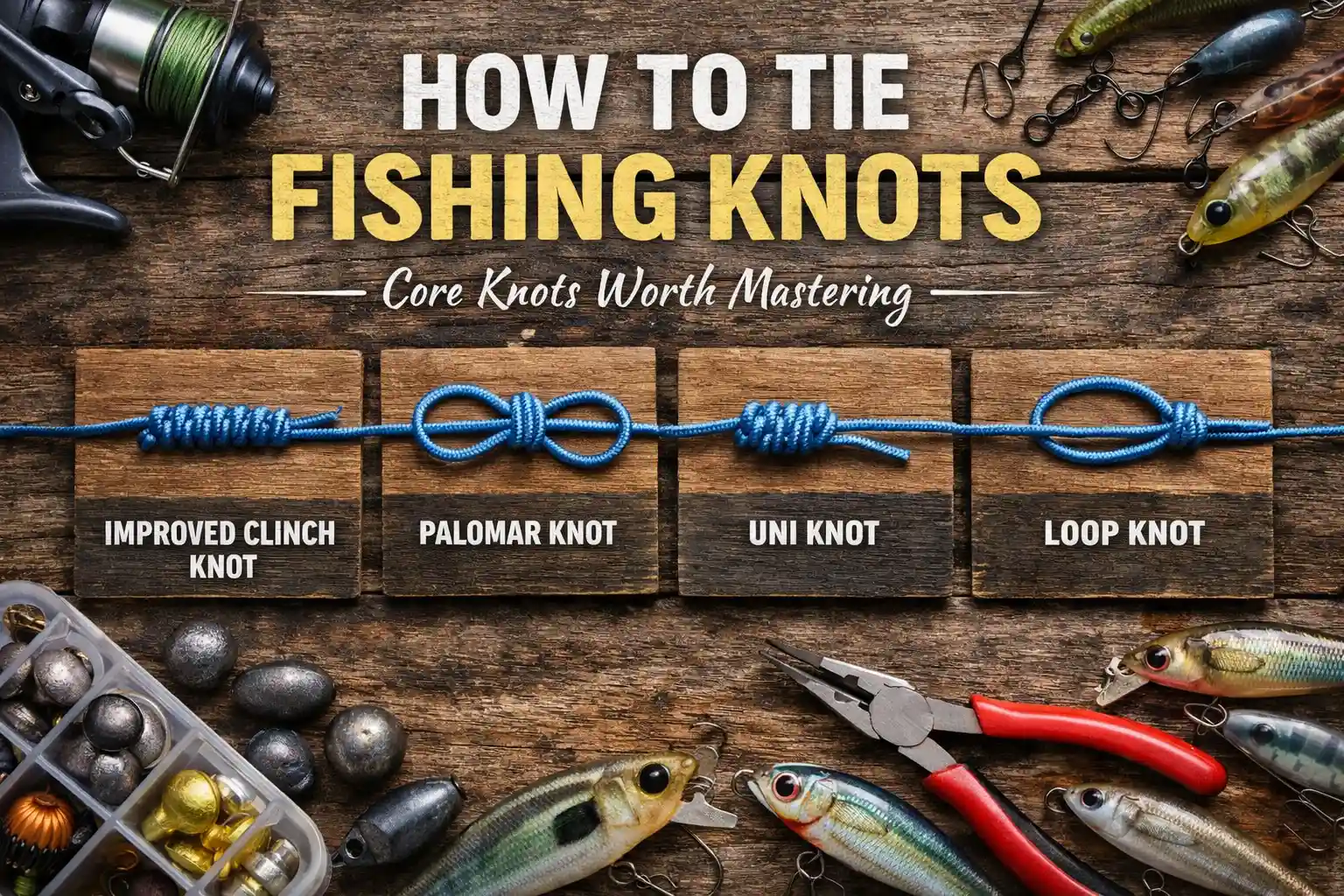
The Palomar Knot: Best Overall for Hooks and Lures
The Palomar knot has built a reputation over decades as the most reliable terminal connection available. Professional bass tournament anglers, inshore saltwater guides, and fly fishermen all use it regularly. It works on monofilament, fluorocarbon, and braided line, though it really shines with braid because of how the doubled line distributes stress across the hook eye.
To tie it, double about six inches of line and pass the doubled section through the hook eye from front to back. Tie a loose overhand knot with the doubled line, keeping the hook hanging free below it. Take the loop end of the doubled line and pass it completely over the hook, over the entire hook shank, and pull it up behind the overhand knot. Before pulling tight, wet the knot with saliva. Then pull smoothly on both the standing line and the short tag end simultaneously until the knot seats firmly against the hook eye. Trim the tag end close.
One thing that trips people up with the Palomar is not passing the loop far enough over the hook. The loop needs to go all the way past the point and clear of the bend before you tighten. Anything less and the knot seats incorrectly. The finished knot should look symmetrical, with the wraps sitting cleanly on both sides of the hook eye.
Why the Palomar Beats the Basic Clinch on Braided Line
Braided line has almost no stretch and a very different surface texture from monofilament. It does not grip itself the way mono does, which means knots that rely on friction between line layers can slip under load. The Palomar sidesteps this problem because the doubled line through the eye and the loop passing over the hook create a mechanical lock rather than relying on friction alone. For braided lines above 15-pound test, the Palomar or a line-specific braid knot will consistently outlast the improved clinch in pull tests.
The Improved Clinch Knot: The Reliable Workhorse
The improved clinch knot is probably the most widely used fishing knot in North America. It is fast to tie, works well on monofilament and fluorocarbon lines up to about 20-pound test, and tests reliably at 90 to 95 percent of breaking strength when tied correctly.
Pass five to six inches of tag end through the hook eye, then make five to seven wraps of the tag end around the standing line, moving back away from the hook. Five wraps work on a heavier line. Seven wraps suits lighter line where more surface contact helps prevent slipping. After wrapping, bring the tag end back down and pass it through the small loop that formed just above the hook eye, then pass it back through the large loop you just created. Wet the knot. Pull slowly and steadily on the standing line while holding the tag end until the wraps compress neatly against the hook eye. Trim close.
The “improved” part of the name refers to that final tuck back through the large loop. Without it, you have a basic clinch knot that tests around 75 to 80 percent. That extra tuck adds the security that makes the improved version worth the one additional step.
Common Mistakes That Weaken the Improved Clinch
The wraps crossing over each other rather than lying parallel is the most frequent error. When the coils stack instead of laying in a clean spiral, the line cuts into itself under pressure. Tying too fast almost guarantees this. Another common problem is pulling the tag end only while tightening, which causes the wraps to loosen rather than cinch. Always pull the standing line to seat this knot correctly.
The Uni Knot: The Versatile One
The uni knot, sometimes called the Duncan knot, earns its place in any angler’s core rotation because it handles multiple connection types with the same basic structure. You can use it to tie terminal tackle to the end of your line, join two lines together in a double uni configuration, or attach a leader to your main line.
To tie it for a terminal connection, pass six inches of line through the hook eye and bring it back parallel to the standing line, forming a loop alongside both line sections. Wrap the tag end around the two parallel lines six times, passing each wrap through the loop you formed. Wet the knot and pull the tag end to snug the wraps into a compact coil. Slide the coil down to the hook eye by pulling the standing line. The knot should sit firmly with no gaps between wraps.
The sliding characteristic of the uni knot also makes it useful when you want to leave a small loop for lure action rather than pinching the lure tight against a cinch knot. Leave a quarter inch of space before seating the final position, and you have a loop connection that lets a lure swing freely on the hook eye.
The Double Uni Knot: Joining Lines of Different Sizes
Any time you connect a fluorocarbon leader to a braided main line, or join two sections of monofilament with different diameters, the double uni is among the most dependable options available. It tests consistently above 85 percent of the weaker line’s rating and passes through rod guides with minimal catching.
Overlap the two lines by about 12 inches. Make a loop with one line back over both lines together, then wrap the tag end through the loop six times. Pull the tag end to snug those wraps into a compact coil. Do the same with the other line, wrapping six turns in the opposite direction. Pull both standing lines in opposite directions until the two uni knots slide toward each other and meet in the middle. Wet thoroughly before making that final pull. Trim both tag ends close to the knot barrel.
On heavier braided lines, some anglers increase the wrap count on the braid side to eight or ten turns since the slicker surface benefits from more contact wraps. The mono or fluorocarbon side stays at six.
Line-to-Line Connections That Hold Under Pressure
The FG Knot: Lean Profile, Serious Strength
The FG knot has earned serious respect among saltwater anglers, particularly those fishing braid-to-fluorocarbon connections for species like snook, redfish, striped bass, and yellowfin tuna. It produces a thinner connection profile than the double uni, which means it passes through guides more smoothly and causes less disruption when the leader knot is inside the rod during a cast.
The trade-off is that the FG takes longer to tie and requires some practice before it feels natural. The structure involves weaving the braided line back and forth over the fluorocarbon leader in alternating half hitches, building a series of interlocking wraps that grip the fluorocarbon without the bulk of a stacked coil. Finish it with a series of locking half hitches on the braid itself, then half hitch the tag end back down the leader, and trim.
For anglers who spend time offshore or targeting large inshore species where casting distance and leader-through-guides presentations matter, learning the FG is worth the investment. Pull-test it several times before trusting it on a fish.
The Surgeon’s Knot: Quick and Effective
The surgeon’s knot (or double surgeon’s knot) handles leader-to-mainline connections quickly, which matters when you are on the water and need to re-rig fast. It works well across lines of different diameters and tests reliably in the 75 to 85 percent range of the weaker line.
Overlap the leader and main line by 12 to 15 inches. Form an overhand knot using both lines together, but instead of tightening, pass both the leader tag end and the main line through the loop a second time. Tighten by pulling all four strands simultaneously. The knot tightens into a compact cluster and trims up neatly. It is not as strong as the double uni or FG, but for lighter freshwater applications where speed matters more than maximum strength, it does the job reliably.
Loop Knots That Give Lures Freedom to Move
The Non-Slip Mono Loop: Better Action, Strong Connection
Jerk baits, swimbaits, and topwater lures often perform better when they are not pinned directly to a cinch knot at the hook eye. A fixed loop knot lets the lure swing freely, which can improve its action significantly in the water. The non-slip mono loop (sometimes called the Kreh loop after the late Lefty Kreh) creates a loop that does not tighten down under load.
Tie an overhand knot in the line about six inches from the end, then pass the tag end through the hook eye and back through the overhand knot. Wrap the tag end around the standing line four to five times for monofilament and six to seven times for fluorocarbon, then pass it back through the overhand knot in the same direction it came from. Wet it and pull carefully on the standing line while holding the tag end. The loop size you want is determined by how much tag end extends beyond the overhand knot before you pass it through the hook eye. A smaller extension makes a tighter loop. Keep this knot to lines under 30-pound test where the wraps seat properly.
How Knot Failure Actually Happens
Slippage: The Most Common Failure Mode
A knot slips when the friction between the wraps cannot hold against the load being applied. This happens most often with braided line on knots designed for monofilament, since braid’s coating is slick and the line resists gripping itself. It also happens when a knot is tightened dry, causing heat from friction to microscopically degrade the line surface before the wraps fully seat. That is why wetting every knot before tightening is not a suggestion. It is the most consistently cited technique across every experienced angler’s advice, because the consequence of skipping it is predictable.
Line Cutting Through Itself
A line-over-line failure happens when one strand of line crosses over another at an acute angle under load, creating a condition where the load-bearing strand effectively saws through the crossing one. This is why coils that cross rather than lie parallel create such a weakness. A knot under a magnifying lens during load will show the exact point where this happens. The wraps at the base of the knot, where the load concentrates most, are where this failure begins.
The best knots avoid acute crossing angles. The structure of a well-formed Palomar or improved clinch keeps wraps lying parallel, so the load distributes across the contact surface rather than concentrating at a single crossing point.
Tag End Too Short
Trim the tag end too close before the knot is fully seated, and you remove the material the knot needs to grip against during the final tightening. The tag end should be trimmed after the knot is completely seated, not before. Leave it a little long during tying, tighten fully, then trim to about one-eighth of an inch from the knot body. That small stub prevents the knot from walking back through itself under sustained pressure.
Matching the Knot to the Line Type
Monofilament
Monofilament has stretch, some surface friction, and a round cross-section that wraps cleanly. The improved clinch, Palomar, and uni knot all perform well on monofilament. Five to seven wraps on a clinch is appropriate. This line type forgives minor tying imperfections better than braid or fluorocarbon because the stretch absorbs some of the shock that would otherwise stress a poorly seated knot.
Fluorocarbon
Fluorocarbon leader material is stiffer than monofilament and has less surface friction. Knots seat more slowly on fluorocarbon and require more deliberate, even pulling to compress correctly. Rushing the tightening process is the main reason fluorocarbon knots fail. Wet the knot generously and pull slowly, checking that the coils are compressing evenly before finishing. Fluorocarbon also has low stretch, so a knot that is barely adequate on monofilament may fail on fluorocarbon under the same load.
Braided Line
Braided fishing line has almost no stretch, high strength relative to diameter, and a slick surface that makes friction-based knots unreliable. The Palomar and double uni knot suit braid well. The FG knot is excellent for braid-to-leader connections. On heavier braid, increasing the wrap count on the braid side of a double uni from six wraps to eight or ten wraps improves holding power. Some guides recommend a drop of gel super glue on the finished knot when using braid in heavy saltwater applications, applied after the knot is fully dry.
Building Habits That Protect Every Knot You Tie
Check the Line Before You Tie
Before tying any knot on the water, run eight to ten inches of line between your fingers. Line abrasion from rubbing against rocks, dock pilings, or gill plates creates invisible damage above the terminal connection. If you feel any roughness or stiffness, cut that section off and tie your knot on fresh line. A perfectly tied knot on damaged line will still fail under pressure.
Wet Every Knot Before Final Tightening
Saliva works fine. Water from the river works fine. The point is to reduce the heat generated by friction as the wraps compress. Heat from a dry-tightened knot on monofilament or fluorocarbon can reduce tensile strength measurably at the knot. This step costs nothing and takes one second. Skip it consistently, and you will lose fish that should have been landed.
Tighten Slowly and Evenly
Fast, jerky tightening on a knot causes the wraps to stack rather than sit in sequence. Pull steadily on all relevant ends at the same time, watching the knot take shape before applying full pressure. Once the knot is mostly compressed, a final firm pull seats it completely. The difference in knot integrity between a carefully tightened connection and one pulled quickly is visible when you examine both under any magnification.
Re-Tie After Landing a Large Fish
A fish that runs hard, jumps, or puts sustained pressure on a knot can alter the wraps in ways that weaken the connection even if the knot holds. After landing a fish that pushed your tackle hard, clip the knot off and re-tie on fresh line. This takes 90 seconds and eliminates a hidden failure point before the next cast.
Test the Knot With a Sharp Pull Before Casting
After tying any terminal knot, grip the hook between thumb and forefinger and pull sharply on the line to simulate hook-set pressure. A knot that is going to slip will slip during this test rather than during a fight. If the knot moves even slightly, cut it off and start over. The few seconds this takes at the boat or bank side is far better than learning the same lesson when a fish is on.
Knot Selection by Fishing Situation
Light Freshwater Fishing
For trout, panfish, and smaller bass on 6 to 12-pound monofilament, the improved clinch is fast, reliable, and adequate for everything you are likely to encounter. Tie it with six wraps and the extra tuck, wet it fully, and trim the tag end. On light lines where every fraction of a pound of force matters, the Palomar is a worthwhile upgrade for hook and lure connections.
Bass Fishing with Braided Line
Braided main line to a fluorocarbon leader, then a Palomar knot from the leader to the lure covers most bass fishing situations. The Palomar holds on heavy fluorocarbon in the 15 to 20-pound range, and the double uni connecting the braid to the leader passes through guides without catching on a standard cast. Tournament anglers in this category often re-tie their leader-to-lure knot every few hours during competition rather than trusting a knot that has been soaked, stressed, and potentially abraded through hours of casting.
Heavy Saltwater Applications
Offshore fishing for large pelagic species, inshore fishing for tarpon or large redfish, or any application where the fish can weigh triple digits, demands maximum attention to knot quality. The FG knot for braid-to-leader is the choice of most serious saltwater guides. A doubled line connection using a Bimini twist at the end of the main line before attaching the leader adds an additional layer of security for the most demanding situations. This level of rigging takes practice at home before it becomes fast and reliable enough to use on the water.