
9 Proven Lake Fishing Tips: How to Catch Fish in a Lake For Every Time
Let me be straight with you right now: most beginner fishing guides are written by people who forgot what it felt like to not know anything. They assume you already know what a bail is, what “structure” means, and why anyone would use a 2/0 hook instead of a 4/0 hook.
You don’t know yet. That’s fine. That’s the whole point of this.
I’m going to tell you exactly what to do from the first time you walk up to a lake with a brand-new rod in your hand to the moment you hold up your first fish and think, wait, I actually did that.
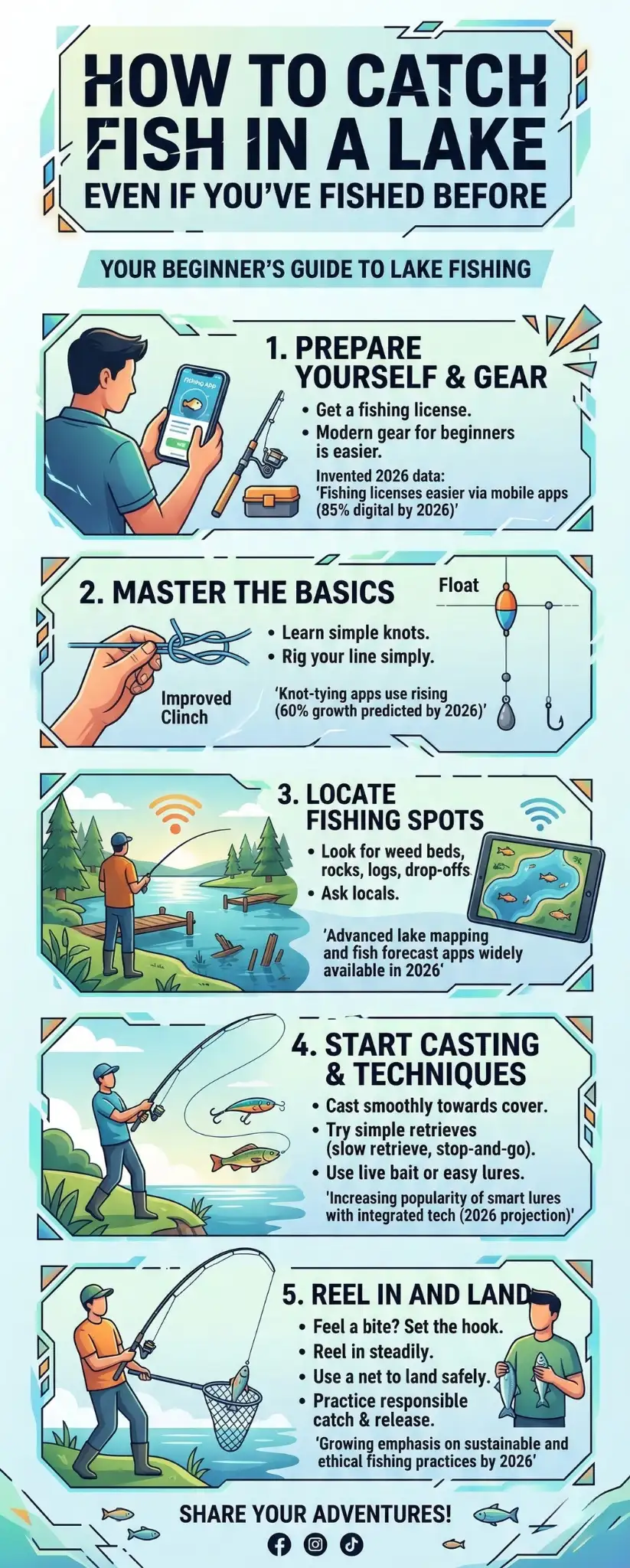
By the end of this, you’ll know where fish hide in a lake, what bait to use, when to go, how to set your rod up, and what to do when you feel a bite. No jargon. No, assuming you know anything. Let’s get into it.
Why So Many Beginners Leave the Lake Empty-Handed
Here’s the honest truth that almost no fishing website will tell you: the gear is not the problem. New anglers lose fish or catch nothing because they have the wrong rod or the wrong reel. It’s because they’re standing in the wrong spot, fishing at the wrong depth, using bait that’s too big, or setting the hook too early.
Every single one of those problems is fixable in about five minutes once you know what’s causing it. That’s what this guide is about.
Step 1: Get a Freshwater Fishing License Before You Leave the House
This is the step most first-timers skip, and then get a very unpleasant surprise about.
In every state in the US, you need a valid freshwater fishing license to legally fish a lake. Game wardens patrol popular spots, especially on weekends. Getting caught without one is a real fine, anywhere from $50 to $500, depending on the state.
Getting a license takes literally five minutes:
- Google “New York fishing license”, your state fish and wildlife agency will be the first result
- Buy online and screenshot it on your phone
- Or pick one up at Walmart, Bass Pro Shops, Dick’s, or any local bait shop
If you’re just testing it out, most states sell one-day or three-day licenses for $7–$15. You don’t have to commit to a full year before you know if you like it.
While you’re buying your license, grab a copy of your state’s fishing regulations. It’s free, either a printed booklet at the counter or a PDF on the agency website. Skim the freshwater section for the lake you’re going to. You’re looking for:
- Size limits: the minimum length of fish you can legally keep
- Bag limits: the maximum number of fish you can keep per day
- Special rules: some lakes are catch-and-release only or have bait restrictions
You don’t have to memorize it. Just know it exists and have it accessible.
Step 2: Know What Type of Lake You’re Fishing (It Changes Everything)
This is the single most underrated piece of beginner knowledge out there, and almost no guide covers it well.
Natural Lakes vs. Man-Made Reservoirs
Natural lakes were formed by glaciers, geological shifts, or volcanic activity. They tend to have thick shoreline vegetation, lily pads, reeds, cattails, and submerged grass, and that vegetation is where fish live. When you’re at a natural lake, work the edges of weed beds and lily pad fields. That’s where largemouth bass, bluegill, and northern pike hunt.
Man-made reservoirs were created by flooding river valleys. That means the old creek bed, flooded timber, road beds, and bridge foundations are still down there, just underwater. These submerged structures are fish magnets. The old creek channel is often the deepest part of the reservoir, and fish use it as a highway. Before you go, look up the reservoir on Google Maps satellite view. You can often spot the old drainage channel even from the air.
Why does this matter to you as a beginner? Because if you walk up to a reservoir and cast into open, featureless water away from any structure, you’ll sit there all day with nothing. If you walk up to a natural lake and cast into the middle instead of near the weeds, the same result.
Simple rule: Find the edge between something and something else, weeds and open water, shallow and deep, mud and rock. Fish live on those edges.
Step 3: Pick Your Spot on the Bank (This Wins or Loses the Day)
You do not need a boat to catch fish from a lake. Bank fishing works extremely well when you know what to look for.
Walk the shoreline before you cast. Seriously. Give it five minutes. You’re looking for these spots:
Docks and boat ramps: Dock pilings create shade and give fish something to hide behind. Fish stack up under docks, especially in the middle of sunny summer days when they want to get out of bright light. Cast parallel to a dock, not straight at it.
Fallen trees and brush piles: Any log, branch pile, or fallen tree that extends into the water is an ambush zone. Bass, crappie, and perch hide inside that structure waiting to pick off passing baitfish. Cast your bait right into the edge of the brush — as close as you can get without snagging.
Rock piles and riprap banks: Rocky shoreline sections (common near dam faces and boat launches) hold smallmouth bass and perch. The rocks absorb heat from the sun and stay warmer than the surrounding water in early spring, which brings fish in early in the season.
Vegetation edges: Where the weeds stop, and open water starts, is a feeding lane. Bluegill, sunfish, and bass sit just inside the edge of the weeds and pick off insects and small fish that wander too close. Cast just past the weed line and slowly pull your bait back toward open water.
Inlets and outlets: Where a stream enters the lake (inlet) or where water drains out (outlet) is one of the most consistently productive bank fishing spots on any lake. Water flowing in carries oxygen and delivers food. Fish stack up here, especially during warm months when the rest of the lake gets depleted of oxygen.
Points: A point is a finger of land that juts out into the lake. At the tip of that point underwater, multiple depth zones meet in one small area. Bass and walleye cruise these intersections constantly.
Quick depth change zones: Wade in slowly and watch where the bottom drops off quickly. Where shallow water meets a sudden drop into deeper water is called a drop-off. It’s one of the highest-percentage spots in any lake, any season.
Step 4: Build a Beginner Rod Setup (And What to Skip)
Walk into Bass Pro on a Saturday, and you’ll see $500 rod combos that will make you think you need to spend serious money to catch fish. You don’t. Here’s the honest beginner setup:
Rod and Reel
Get a 6 to 7-foot spinning rod and reel combo. This is the right call for a first-timer. Spinning gear is forgiving, casts well, and works for every freshwater lake species. Budget: $35–$80 for a complete combo. Look for the Shakespeare Ugly Stik GX2 combo or the Zebco Roam spinning combo; both are under $60 and genuinely good.
If you’re setting up a kid under 10, a spincast combo (push-button reel) is even easier. The line goes out automatically when you push the button and release it on the forward cast.
Ignore baitcasters for now. They’re excellent tools with a legitimate learning curve, and this is not the time.
Fishing Line
Most combos come pre-spooled. If yours doesn’t, pick up 6 lb monofilament line. It’s cheap, it stretches a little (which saves you when a fish runs), it’s easy to tie knots in, and it floats well for bobber fishing.
- 4–6 lb mono for bluegill and panfish
- 8–12 lb mono for bass and catfish
That’s the whole line decision. Move on.
Terminal Tackle (Hooks, Sinkers, Bobbers)
This is what goes on the end of your line, and it matters more than the rod does.
Hooks:
- Size 8 or size 6 for bluegill, perch, and sunfish
- Size 2 or 1/0 for largemouth bass
- 3/0 or 4/0 for catfish and channel cats
- Buy a multipack assortment; they cost about $3
Split-shot sinkers: These are small, round weights you pinch directly onto your line with your fingers. Clamp one 6–12 inches above your hook. They sink your bait to the right depth.
Bobbers: The classic red and white clip-on bobber works fine. A slip float is slightly better once you have a trip or two under your belt; it slides freely on the line and casts much cleaner.
Total cost for hooks, sinkers, and bobbers: under $10.
Step 5: Choose Your Bait (And Why Beginners Should Not Start With Lures)
Every experienced angler will tell you: live bait catches more fish than lures for beginners. The reason is simple, live bait moves on its own and smells real. You don’t have to impart any action, time any retrieve, or guess what color a bass might want today. The bait does the work.
Here are the best options ranked for ease and effectiveness:
Nightcrawlers (Earthworms)
This is the number one beginner bait in North America, full stop. Nightcrawlers catch bluegill, perch, bass, catfish, crappie, and trout. Buy a carton at Walmart, sporting goods, or any bait shop for about $3.50. They stay fresh in the refrigerator for up to two weeks.
The key hook technique that beginners get wrong: Don’t just thread the worm on once. Push the hook through the worm three or four times, bunching it up on the hook shank. Leave only a short tail hanging. A long dangling worm gets nibbled off without ever getting the fish hooked.
Live Minnows
For bass, crappie, and walleye, a live minnow on a hook is almost unfair. Hook the minnow through the back just behind the dorsal fin, not through the mouth. This lets it swim naturally. Run it under a bobber or free-line it along the bottom near structure.
PowerBait
If you’re fishing a stocked trout lake or trout pond (common at state parks, wildlife management areas, and recreation lakes), PowerBait is close to cheating. It’s a scented, brightly colored dough you roll into a small ball around a treble hook. Cast it out, let it sink to the bottom, and wait. Stocked rainbow trout hit it hard.
Crickets
Walk into any bait shop and ask for a dozen crickets. Drop one on a size 8 hook under a bobber near any dock or weed edge. Bluegill will hit it within minutes. This is the move if you want your kid to catch a fish fast.
Chicken Liver
Ugly, smelly, and incredibly effective for channel catfish. Catfish feed almost entirely by smell, and their sense of it is extraordinary; they can detect food from hundreds of yards away. Bait a size 3/0 or 4/0 hook with a chunk of chicken liver, drop it on the bottom, put your rod in a holder, and wait.
Step 6: Rig Up Your Rod (Step-by-Step)
Here’s the classic bobber rig, the most beginner-proof setup in freshwater fishing:
Step 1: Clip your bobber onto the line. For a 2–3 foot water depth, put the bobber about 2.5 feet above where your hook will be. For deeper water near a dock or drop-off, slide it up to 4–5 feet.
Step 2: Pinch one split-shot sinker onto the line about 8–10 inches above the hook. If there’s light current or wind, add a second sinker right above the first.
Step 3: Tie your hook using the Improved Clinch Knot:
- Pass 6 inches of line through the eye of the hook
- Wrap the loose end around the main line five times (count them)
- Pass the loose end through the small loop near the hook eye
- Pass it back through the large loop you just created
- Wet the knot, put it in your mouth, and get it wet before tightening. This stops friction heat from weakening the line
- Pull both the main line and the tag end firmly in opposite directions until tight
- Trim the tag end close with nail clippers or scissors
Pull on it hard. If it holds, you’re ready. If it slips, untie and try again; it’s worth getting right.
Step 4: Bait the hook. You’re set.
Step 7: Cast From the Bank (You’ll Get It in 3 Tries)
With a spinning reel, here’s the basic overhead cast:
- Hold the rod with the reel hanging down (under the rod, not on top)
- Open the bail that metal curved arm on the reel by flipping it over with your free hand
- Place your index finger on the line, pressing it against the rod grip
- Face your target and bring the rod back to about the 2 o’clock position (just past vertical behind your shoulder)
- Swing the rod forward firmly toward your target
- Release your index finger when the rod tip reaches eye level, and the line is pointing toward the water
- As soon as the bait hits the water, close the bail by turning the reel handle once
Common mistake: releasing too late. If your bait lands at your feet, you’re letting go too late in the swing. Try releasing earlier — when the rod is more vertical, not fully forward.
How far should you cast? Not as far as you can. Most fish near the bank hold within 15–30 feet of the shore. Accurate, controlled casts near visible structure beat long, wild casts into open water every time.
Step 8: Know When to Fish a Lake (This Is the Cheat Code)
The single biggest mistake beginners make besides fishing in the wrong spot? Fishing at the wrong time. You can do everything else right and still sit there for hours if you show up at noon on a hot summer day and cast into a sun-baked cove.
Time of Day
Dawn to 9 AM is the prime window. Water is coolest, fish are shallow, and they’re actively feeding. This is when largemouth bass and bluegill are most accessible from the bank.
Evening, from about 5 PM until dark, is your second-best window. Water temperature drops, fish move back toward shallow feeding areas, and low light makes them less cautious.
Midday in summer, the fish aren’t gone; they’re just sitting 15 feet underwater where it’s cold and comfortable. You can catch them, but it requires fishing deeper and more slowly.
Season
Spring (April–May in most of the US) is the best season for a first-time angler to catch fish. This is spawning season, bluegill, bass, and perch move into the shallows in huge numbers, and they’re aggressive. A worm on a hook near any shallow flat or dock will get bites.
Fall (September–October) is close behind. Fish are feeding heavily before water temperatures drop. They’re predictable, they stack up near the same structures they used all summer, but in shallower water as temperatures drop.
Summer fishing is real, but you absolutely must go early. Arrive at the lake before sunrise, and you’ll catch fish in the first two hours. Come back at 10 AM and wonder where they went.
Winter fishing works for catfish and trout, but it’s slower and requires patience. If you’re a beginner in a cold state, wait for spring.
Weather
Overcast days flat-out fish better than sunny days. Under clouds, fish feel less exposed and roam more freely into open water. They feed bolder and bite more aggressively.
After light rain, surface insects fall into the water, and baitfish come to the surface to eat them. Bluegill and bass follow. The 30–60 minutes after a light rain ends is often the best fishing of the day.
Before a major storm, as the barometric pressure drops, there’s often a brief feeding surge. Fish sense the pressure change and feed hard. If a storm is rolling in, that window before it arrives can be electric.
Step 9: Feel the Bite, Set the Hook, and Land the Fish
This is the part that separates a fish from a story about a fish you almost caught.
Watch the Bobber
When a fish is checking out your bait, the bobber will twitch or bob lightly. Don’t set the hook yet. That’s just the fish mouthing the bait. Wait.
When the bobber goes fully underwater and stays down, that’s a fish that has the bait in its mouth and is moving. That’s your moment. Lift the rod tip sharply and firmly, straight up. Don’t yank sideways. A straight upward lift drives the hook point into the fish’s mouth.
If you set the hook too early and get nothing, that’s very common. The fish was still testing the bait. Next time, make yourself count to two before you sit.
Fight the Fish
Once the hook is set and you feel the fish pulling, keep your rod tip up at about 45 degrees. Reel steadily when the fish swims toward you. When the fish runs and takes the line, let it. Don’t force it or your line will snap.
The drag system on your spinning reel is designed for this. It releases line at a set tension so the fish can’t break it. If the fish is pulling line out, that’s normal; it’s tiring itself out. When it stops running, reel it back in.
Land the Fish
When the fish is close, wet your hand before grabbing it. This protects the fish’s natural slime coat (the mucus layer that prevents infection). Grip the body horizontally or lip the fish by the lower jaw for bass; they don’t have sharp teeth, and the lip grip holds them still safely.
For bluegill and panfish, grip the fish gently from above, keeping the dorsal fin flat so the spines don’t stick you.
The Best Fish to Target in a Lake for Your First Time
Not all fish are created equal for beginners. Here’s who to target first:
Bluegill, Start Here
Bluegill are the most widely caught fish in America for a reason. They’re in almost every lake in the country, they bite hard on a small hook and worm, they fight well for their size, and they’re fantastic eating. A size 8 hook, a small piece of nightcrawler, a bobber at 2 feet, near any dock or weed edge, that’s the entire setup. If there’s a bluegill within 20 feet of where you cast, it will probably bite.
Largemouth Bass
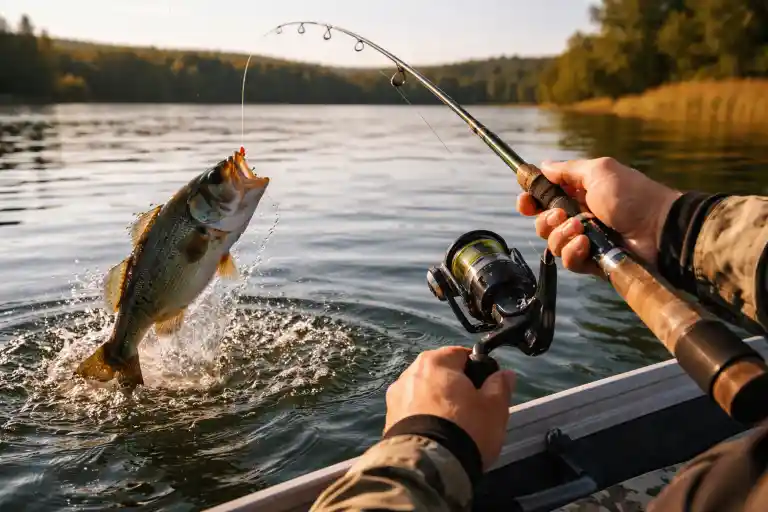
When a largemouth grabs your bait, you’ll know it. They hit hard, pull hard, and jump. They live near structures in almost every US lake. A live minnow or a Texas-rigged plastic worm near any submerged brush or dock will get you strikes. This is the fish that turns casual anglers into obsessive ones.
Channel Catfish
You don’t need a technique to catch catfish. You need smelly bait and patience. Set up a bottom rig with a chunk of chicken liver or a nightcrawler, prop your rod in a forked stick or rod holder, and wait. They bite at dusk and after dark better than during the day.
Rainbow Trout (Stocked Lakes)
If there’s a state park near you with a stocked trout lake, this is one of the easiest first-fish scenarios possible. Stocked rainbows are aggressive, naïve, and packed into a relatively small area. PowerBait on the bottom wins.
Crappie
Crappie school up, find one, find fifty. They love submerged brush piles and flooded timber in man-made reservoirs. A small jig (1/16 oz marabou jig) or a live minnow under a float near any deep, brushy structure is the move.
Why You Might Not Be Catching Fish (And How to Fix It Fast)
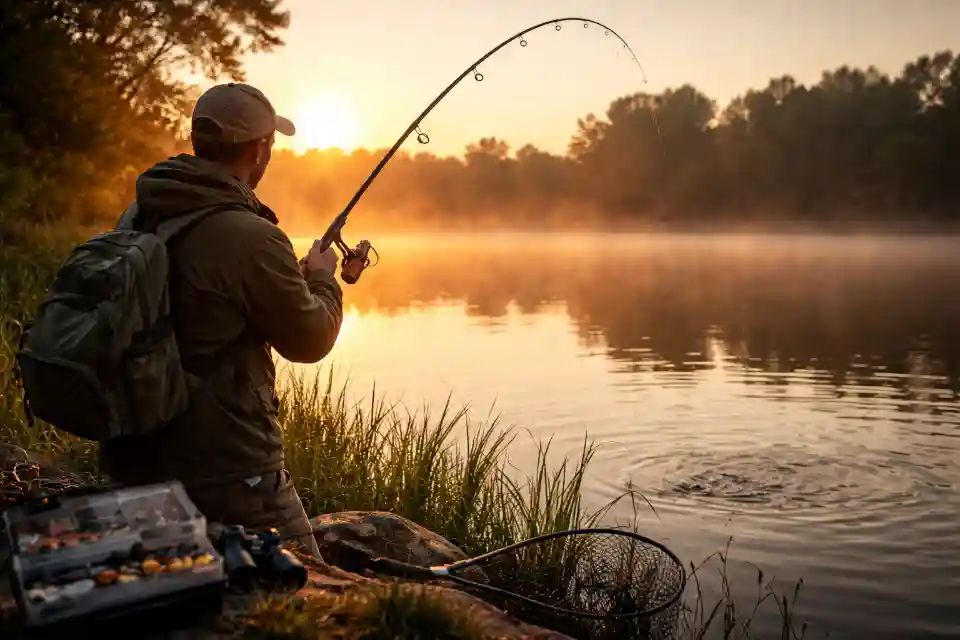
If you’ve been at it for 30+ minutes with zero action, run through this list:
Are you in the right spot? Open water with no structure is the most common mistake. Move to a dock, a weed edge, or a fallen tree.
Is your depth right? If your bobber is set at 2 feet but fish are holding at 5 feet, they’ll never see your bait. Try adjusting your depth every 15 minutes.
Is your bait fresh? Nightcrawlers should still be moving. A dead, pale worm is much less effective than a lively one. Keep them in a cool container.
Is your hook too large? A size 2/0 hook trying to catch bluegill won’t work. The fish physically can’t get it in its mouth. Match your hook to the fish; small hooks for small fish.
Are you setting the hook too early? The single most common reason beginners lose fish is letting the bobber go all the way under before you lift the rod.
Have you moved in the last hour? If a spot hasn’t produced in 30–45 minutes, move. Walk 50–100 feet down the bank and try fresh water. Fish don’t always come to you; sometimes you come to them.
Are you making too much noise? Fish feel vibrations through the water. Heavy footsteps on a dock, dropping gear, splashing around, it spooks fish out of the area. Move quietly and keep your shadow off the water.
Catch and Release: How to Do It Right
Even when you’re allowed to keep fish, releasing them is always an option, and it keeps lake populations healthy for everyone.
The right release:
- Wet your hands before touching the fish
- Keep the fish in the water as long as possible during hook removal
- If the fish swallowed the hook, cut the line close to the mouth; don’t rip it out. The hook will rust and dissolve in a few weeks
- Hold the fish horizontally in the water, facing into any slight current or just gently moving it back and forth so water flows through its gills
- When the fish kicks and swims strongly on its own, open your hand and let it go
A fish released properly survives almost every time. A fish yanked, tossed, or left out of water for too long has a much lower chance.
Your First Lake Fishing Checklist
Before you leave the house:
- Freshwater fishing license (on your phone or printed)
- Rod and reel combo, pre-rigged with bobber, sinker, and hook
- Fresh live bait nightcrawlers and/or minnows
- Extra hooks and a few split-shot sinkers
- Needle-nose pliers (for hook removal, do not skip this)
- Polarized sunglasses (they let you see fish, weed edges, and structure through the water)
- Small landing net
- Sunscreen and bug spray
- Water and snacks, you’ll stay longer than you planned
- An ice chest if you plan to keep fish
People Also Ask: Straight Answers
What is the best bait for catching fish in a lake as a beginner?
Nightcrawlers. They catch every common freshwater species: bluegill, bass, catfish, perch, and trout. Buy a carton at Walmart for $3.50, use a size 6–8 hook, and fish under a bobber near any dock or weed edge. It’s not complicated.
Where do fish hide in a lake?
Anywhere they can ambush food or find shade: under docks, inside fallen trees and brush piles, along weed edges, at depth changes and drop-offs, near inlets, and around rock piles. Stay away from open, featureless water.
What depth should I fish in a lake?
Start at 2–3 feet with a bobber. If you get nibbles but no hookups, try shallower. If nothing is happening in 20 minutes, go deeper. In summer, fish go deeper during the day. In spring and fall, they’re often in 2–6 feet of water near shore.
Do I need a boat to fish a lake?
No. Bank fishing produces excellent catches from any lake. You need to know what to look for on the shoreline — docks, fallen trees, weed edges, inlets, and rocky banks. The fish are right there.
What time of day is best for lake fishing?
Early morning from first light to 9 AM is the single best window. Late afternoon to dusk is a close second. Midday on a sunny summer day is the toughest time to catch fish from the bank.
Why can’t I catch fish in a lake?
Most likely reason: wrong location. Cast near structure, docks, weeds, logs, rocky banks, not open water. Second most likely: wrong depth. Third most likely: setting the hook too early. Fourth: hook size doesn’t match the species.
What fish should a complete beginner target in a lake?
Bluegill, without question. They’re in every lake, they bite hard and often, they’re easy to handle, and they’re delicious. Once you’re comfortable with bluegill, move to bass and catfish.
Is lake fishing better in the morning or evening?
Morning wins. The hour after sunrise is peak feeding time for most lake species. Evening is a close second, especially in summer when morning windows are short before it gets too hot.
One Last Thing Before You Go
I want you to expect this: your first trip might produce nothing. That happens. It happens to people who have been fishing for 20 years in unfamiliar water. What matters is that you pay attention to what’s happening. Notice where other anglers are catching fish and why. Notice where the structure is. Notice what time the bites started and stopped. Every trip teaches you something, whether you catch a fish or not.
But if you follow this guide, fish near structure, use fresh live bait, go early, set your depth right, and let the bobber go fully under before you set the hook, you have a genuinely good chance of catching something on your first trip.
The lake doesn’t care that you’ve never done this before. The fish will bite if you put the bait in front of them. Go find them.